
On Heat
plus a poem

Somehow June is almost ending. First, before anything else: a new poem in The New Yorker! All gratitude to the editors. I’m trying to be chill about it, but I’m pretty delighted. This one’s not from Middle Slope, which means if you pre-order the book the poems should all still be fresh for you.
For this month, I had planned a post about a gorgeous week at Convent Arts, in Cape May, New Jersey, and the delights and strangeness of my first-ever writing residency. But next week we head to London and then Paris, where we’ll spend most of July, and my heart’s in Paris already—it often is, anyway—and it’s impossible to ignore the weather there right now, so I’ll save the residency recap for July.
On the hottest day of the heat wave that continues still, Paris hit a record of nearly 106 degrees Fahrenheit. That was Wednesday, six days before our departure. I’m reading the headlines with some trepidation for our trip, but not too much: I know a Parisian heat wave, and although I could be wrong, I don’t think it will last. But it’s impossible not to be terrified by these temperatures, the second heat wave this year already, and I wanted to write a little about heat, although the only conclusions I have are banal and all I have to offer instead is description.
I grew up in the south; I love heat. I love a humid summer evening that turns into a hot summer night. I dislike air conditioning even more than I dislike winter. I find it easier to leave the house when it’s hot outside, easier to dress: a dress, say, sunglasses, wet hair. Maybe it’s in my head, but I think my skin looks better when it’s hot. Actually I think almost everyone looks better when it’s hot, even if they’re sweating a little.
In Paris, where I’ve spent time every summer (with one pandemic exception) for the past 21 years, the heat wave—canicule—has been a fixture. I’ve always liked the word “canicule,” which appears to derive from the Latin for the dog star, Sirius, the brightest star in the sky and at its peak in summer. Canicule, canine, the dog days of summer. Twenty years ago I wrote a poem called “Canicule” (“gold like shouting / hung from a stillness that accepts no decoration // and impossible. How do you call / this bold new style that the sun / cuts for the day?”) and emailed it to myself. My inbox, pretentiously, also contains many instances of me using the word in English, instead of “heat wave.” I even turned it into an adjective, “canicular.” “I hope the canicular conditions have abated,” I wrote. “Canicular” as in “funicular,” a ride.
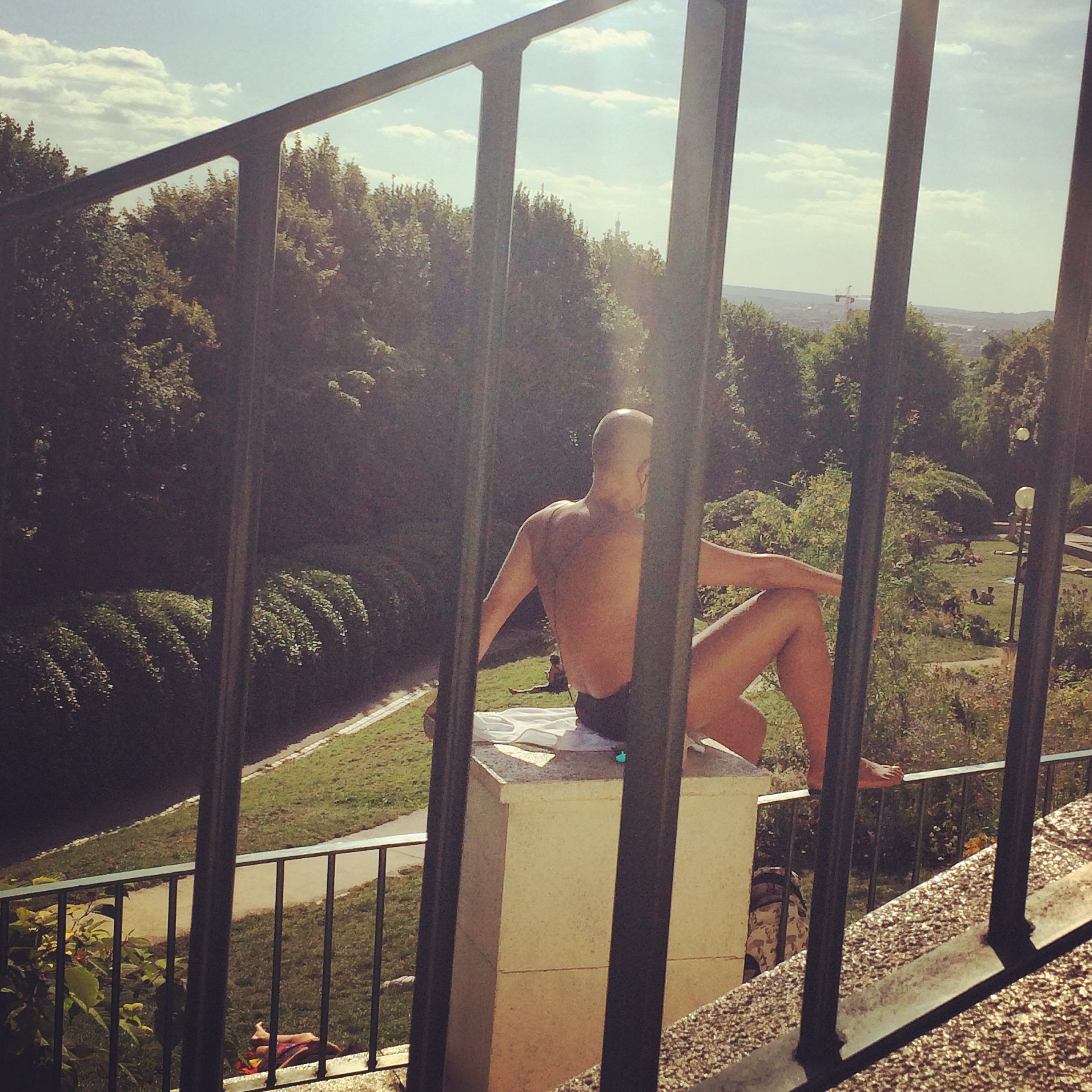
My days of Paris canicule, seen from a slight remove, have taken on a certain shimmer. In fact they did shimmer. I loved those days best. Because I was a student or graduate student for more than half of my Paris summers, I had little to do and nowhere to be. I planned my days around shade, staying indoors reading or working, avoiding the metro, which can be stifling. I slept late, ate fruit for at least two meals, guzzled mineral water, met friends at the movies if it got bad. If it got really very bad, I went to the BN, the national library, which has air conditioning, but that was a last resort.
In the endless evenings, we sat out by the canal until very late and drank wine (not cold) and watched people jump in from the little bridge. By the time I got home, always on foot, it was little cooler, and I woke late again, sometimes to the scuffling of a pigeon who’d come in through a kitchen window. The apartments I rented were small and tended to be high up, because I find low floors in the city can be damper and darker and louder, so that I could see the sky over the roofs. In the late afternoon they smelled like hot wood, and as evening fell the sky went blue to gold to dark blue again, all the while terrifically blank except for a few swallows who sounded louder than all the city noise floating up below.
So it was. Now that I have a child, things have changed. The first time we brought Julian to France he was just under six months old. I’d been invited to a literary festival in La Baule, and we took a train from Paris west. Shortly into the trip the train’s cooling system broke, and so my husband and I took turns walking the baby, sleeping or awake, back and forth to the dining car, which was crowded but still much cooler. The baby’s cheeks were flushed, and I was sweating, and we worried. For the very young, like the very old, heat is dangerous. Last summer, we rented a perfect apartment in northeast Paris. It had a gorgeous terrace, a kitchen and living room on a main floor, and then a converted attic, with two tiny bedrooms and a bathroom under the eaves. We missed last year’s heat wave by two days, and I worried about a repeat. Even on warm days it was impossible to keep the upstairs bedrooms, which had only skylights for ventilation, cool. The woman from whom we rented had two young children, so I texted to ask: was there some system for cooling things down—a trick for placing fans? Did they move a bed downstairs? Sleep on the terrace? She returned with the equivalent of a shrug: the kids, she said, had gone to their grandparents’ in Brittany.
Of course it’s not just because I have a child now that things have changed. This year the first Paris heat wave was in May—that’s unheard of. It feels weird and a little geriatric to say it, but the Paris heat waves of my twenties, which were already deadly, are no longer. This new, hotter heat is not a pleasure but a danger. The obligatory disclaimer: for people like me and the people in whose apartments I stay—we’ll be ok. I suppose the worst thing that happens is we have to leave the city, either to pay for a trip somewhere outside the city (lacking, alas, grandparents in Brittany) or to go home. I read an essay about the people who live in the chambres de bonne that exist beneath the zinc roofs across the city. Most of them will be ok too—they’re versions of me in my 20s, students, people with parents and family and friends in the suburbs or the country.
But still, for the very young and the very old, for the unhoused, for the people whose work takes them into dangerous conditions—transit workers, construction workers, farm workers, warehouse workers—and for the people who have nowhere else to go, this heat is deadly, terrifying. Even I, who once loved it, have begun to feel its edge. I guess this is why I wanted to write about the canicule here: it was once a pleasure and now it is not. I have the distinct urge to memorialize it through description, even if it was only a pleasure to me. I miss the dog days, and now I am afraid of them.